How Would Wild Horse Reservoir Be Different than Antero Reservoir?
As Colorado faces a severe drought, Denver Water announced that they would be moving water from Antero Reservoir to Cheesman Reservoir in order to reduce the amount of water lost to evaporation. This brought up a good question: how would the proposed Wild Horse Reservoir Project compare to Antero Reservoir?
While all reservoirs lose some water to evaporation, the proposed Wild Horse Reservoir Project has been intentionally designed with features that make it distinct from and more efficient than Antero Reservoir.
Depth
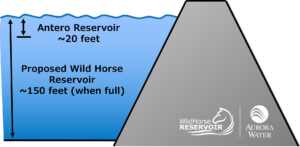 The depth of a reservoir plays a critical role in reducing the percentage of water lost to evaporation. The proposed depth for the Wild Horse Reservoir Project would be around 150 feet when full. Antero Reservoir is around 20 feet deep at its deepest. The primary reason that Antero Reservoir has such a high ratio of evaporation to storage is because it is a shallow reservoir that warms up quickly. The Wild Horse Reservoir Project was intentionally designed with a much greater depth than Antero Reservoir to help minimize the proportion of water that would be lost to evaporation.
Surface Area
Another critical factor in the volume of water lost to evaporation is the surface area relative to the volume of water stored. The proposed Wild Horse Reservoir Project would hold 95,000 acre-feet of water with a surface area of around 1,650 acres. Antero Reservoir holds around 20,000 acre-feet of water with a surface area of around 2,400 acres. The design of the Wild Horse Reservoir Project would expose less surface area for the volume of water stored. This means that the percentage of water volume lost to evaporation in a year at the Wild Horse Reservoir Project would be less than Antero Reservoir—even including periods when the Wild Horse Reservoir would not be full.
Source of Water
Water for the proposed Wild Horse Reservoir Project would be supplied from the Otero pipeline using our existing Colorado and Arkansas river rights that are currently being fed into Spinney Mountain Reservoir. (Read more about how the project would work.) Water for Antero Reservoir is supplied from the middle fork of the South Platte River. Because these reservoirs are part of two different water systems—Denver Water manages Antero Reservoir and Aurora Water would manage the Wild Horse Reservoir—and they rely on different sources of water supply, the ability to fill these reservoirs is not related to one another.
In short, even though the two reservoirs would be close together, the depth, surface area, and source of water make them distinct from one another and ensure that the water storage in the proposed Wild Horse Reservoir Project would be more efficient.