Wild Horse Reservoir Project FAQs
These are the most common frequently asked questions (FAQs) that we have received for the proposed Wild Horse Reservoir Project separated into groups. If you have a question that is not addressed below, please send us your question at WildHorseReservoir@auroragov.org, and we will get back to you as soon as we can.
For more on why Wild Horse Reservoir is needed, please visit the Why Wild Horse Reservoir webpage.
Q. Why is there a need for the Wild Horse Reservoir Project?
A. Aurora Water has one of the most comprehensive and effective water conservation and reuse programs in the country. However, water conservation and reuse alone cannot maintain Aurora Water’s emergency water reserves. The Wild Horse Reservoir Project would provide the critical water storage—like a savings account—that Aurora Water requires to ensure reliable water delivery for community needs and maintain accessible emergency water reserves during severe and prolonged droughts or system emergencies, such as wildfires, pipeline breaks, or system outages.
Q. Is the Wild Horse Reservoir Project needed to support future growth in Aurora?
A. The purpose of the Wild Horse Reservoir Project is to enhance the resilience of Aurora Water’s systems. Through system improvements and comprehensive and effective water conservation and reuse efforts, Aurora Water can meet projected community water needs in 2075 without additional storage but would be unable to maintain its emergency water reserves. The Wild Horse Reservoir Project would enable Aurora Water to provide a reliable water supply while retaining its required emergency water reserves.
Q. Why build another reservoir in Park County rather than in Aurora?
A. Aurora Water evaluated several alternatives located within or near to the city, including expanding existing reservoirs, constructing new reservoirs, and groundwater storage in Aurora. However, most of these alternatives were dismissed because they would not meet the project’s purpose and need, which is maintaining the city’s emergency reserves. For example, most of the options near Aurora could not store the required volume while other sites would have required pumping in and out of the reservoir. Groundwater storage was considered as a combination with Small Wild Horse Reservoir alternative and was also the No Action Alternative.
The proposed Wild Horse Reservoir Project site in Park County did meet the required volume as well as other considerations. Water evaporation and water quality are major issues for reservoirs at lower elevations. The higher elevation in Park County means that reservoirs lose less water through evaporation. Additionally, Aurora Water needed the reservoir to be in the South Platte River basin to ensure that stored water could be accessed during emergency conditions. The project can be easily integrated into Aurora Water’s existing water supply system in Park County, which includes the Otero pipeline and Spinney Mountain Reservoir.
For even more information on how the Wild Horse Reservoir Project would work, please visit the How It Would Work webpage.
Q. Would the Wild Horse Reservoir Project require any new water rights? What does “no new water rights” actually mean?
A. Water stored in the proposed reservoir would be supplied by Aurora Water’s existing Arkansas and Colorado River water rights so no new water rights or decrees would be required for the project.
Under Colorado law, a water right is the right to divert, store, and use water. The proposed reservoir would give Aurora more flexibility and improve resilience throughout our water system. Given our current storage capacity and locations, not all water rights can be stored and used throughout the year.
Q. How would the Wild Horse Reservoir Project be filled?
A. The proposed Wild Horse Reservoir Project would be off channel, meaning the water would come to and from the reservoir via pipelines and no dams would block existing rivers or streams. Water would be supplied into the reservoir through a new inlet pipeline connected to the existing Otero pipeline, which currently conveys Aurora’s water to an open channel that feeds into Spinney Mountain Reservoir. A new outlet pipeline would be constructed to transport water from Wild Horse Reservoir to Spinney Mountain Reservoir as needed. No new water rights or decrees would be needed to fill the reservoir. View project maps with the pipelines on the Documents and Maps webpage.
Q. How long would it take to fill the reservoir?
A. The time needed to fill the reservoir will depend on snowpack, runoff conditions, and Aurora Water’s available water rights. Because these factors vary from year to year, a specific timeline has not yet been determined.
Q. How would the water in Wild Horse Reservoir get to Aurora?
A. Water stored in the proposed reservoir would be released into Spinney Mountain Reservoir via a new outlet pipeline that would connect to Wild Horse Reservoir. Water from Spinney Mountain Reservoir would then be released and flow down the South Platte River through several existing reservoirs (including Eleven Mile Reservoir) before reaching Aurora. View project maps of the pipeline and other reservoirs on the Documents and Maps webpage.
Q. Denver Water drained Antero Reservoir earlier this year. How will Aurora Water be able to fill another reservoir nearby?
A. The proposed Wild Horse Reservoir Project has been intentionally designed with features that make it distinct and more efficient than Antero Reservoir:
- It would be far deeper
- It would have less exposed surface area
- It would have a completely different source of water
The greater depth and smaller surface area would both help minimize the proportion of water in Wild Horse Reservoir that would be lost to evaporation. Learn more in our “How Would Wild Horse Reservoir Be Different Than Antero Reservoir” blog.
Q. What is the length and height of the Wild Horse South Reservoir dam?
A. The dam will be approximately 160 feet high, and approximately 3800 feet long.
Q. What is the final elevation of the water when the reservoir is full?
A. The normal water surface level when full would be 9300 feet at the spillway crest.
Q. How would the Wild Horse Reservoir Project compare to other reservoirs?
A. The Wild Horse Reservoir Project would likely be the 23rd largest reservoir in Colorado when ranked by storage volume. The proposed Wild Horse Reservoir would be Aurora Water’s largest reservoir and would store approximately triple the water volume held by Aurora Reservoir. The table below compares the proposed size, storage, and depth of the Wild Horse Reservoir Project to other Colorado reservoirs.
| Dillon | Aurora | Spinney | Antero | Wild Horse | |
|---|---|---|---|---|---|
| Acres of Land Footprint | 3,233 | 735 | 2,402 | 2,500 | ~1,700 |
| Acre-feet of Water Storage* | 257,304 | 31,604 | 53,651 | 20,000 | ~90,000 |
| Max Depth in ft | 177 | 101 | 60 | 20 | ~150 |
Note: *An acre-foot (af) is 325,851 gallons and is defined as the amount of water it takes to cover an acre of land with one foot of water. One acre is about the size of a football field and can serve three households in Aurora.
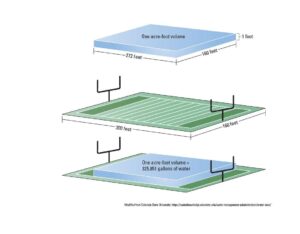
Photo Credit: Water Education Foundation
Q. How will this project be funded?
A. Aurora Water intends to fund the Wild Horse Reservoir Project with a combination of rates and connection fees as the project will benefit both existing and future Aurora customers. It is likely Aurora Water’s ten-year capital program, including the Wild Horse Reservoir Project, will require debt issuance and any available state and federal funding assistance opportunities.
Q. What fieldwork activities are going on this year?
A. Read our Fieldwork Activities in 2026 blog to learn more.
Q. I have seen crews, equipment, or vehicles at one of the locations for the Wild Horse Reservoir Project. Who is working at the possible Wild Horse Reservoir Project sites?
A. No work on the reservoir project is being performed at this time as we are still in the pre-permitting and planning phase. There will periodically be workers at some of the sites conducting field work surveys and geotechnical work with the approval of local landowners. Periodically, there is also maintenance work performed on the Otero pipeline that runs from west to east near the proposed project locations.
Q. What is geotechnical work?
A. Geotechnical work is used to determine what type of soils, rocks, and subsurface geology exists at the site. This involves geological exploration and mapping, including drilling and trenching work. The geotechnical work is performed on Aurora-owned property and some private properties with the landowner’s permission. The data collected through this work is required for the design environmental reviews. Crews and equipment may be seen in various locations.
For even more information on review of the proposed Wild Horse Reservoir Project, please visit the Project Review and Permitting webpage.
Q. What is the status and timeline for the Wild Horse Reservoir Project now?
A. The Wild Horse Reservoir Project is the planning and pre-permitting phase. Aurora Water is working with federal, state, and local government agencies to determine the best path forward for environmental reviews and permitting processes. We expect that the review and permitting processes will take at least two more years. More information will be provided as it becomes available.
Q. Who is doing the project’s environmental review?
A. The Bureau of Land Management (BLM), as the lead federal agency, is managing the federal National Environmental Policy Act (NEPA) review process. Learn more about the NEPA process.
The Colorado Department of Public Health and Environment (CDPHE) will be managing the review of environmental impacts to wetlands and streams under Regulation 87—Dredge and Fill. Learn more about the state review process.
Park County will be reviewing impacts from the project under the Park County 1041 water and wastewater regulations. Learn more about the county review process.
Q. What other permits and authorizations are required?
A. Additional state and local permits and authorizations will be coordinated with the appropriate federal, state, and local government agencies, including Park County. Please see the Project Review and Permitting webpage for the latest information.
Q. How do I find out if the proposed project will affect my property?
A. If you have any questions or would like more information about your property in relation to the proposed Wild Horse Reservoir Project, please email us at WildHorseReservoir@AuroraGov.org and include your Park County Assessor parcel account number or address. In addition, please visit the Working with Landowners webpage for general information.
Q. Is Aurora Water going to start acquiring land for the Wild Horse South Reservoir site?
A. Because the project is in the planning and pre-permitting phase, Aurora Water is not currently seeking to acquire any property. However, Aurora Water is aware that the unknowns around this proposed project do affect property owners and is willing to discuss options for land purchases or trades now rather than waiting for future decisions to be made. If you have any questions or would like more information about your property, please email us at WildHorseReservoir@AuroraGov.org and include your Park County Assessor parcel account number or address.
Q. What is Aurora Water going to do with all the property already acquired for the north site?
A. We are open to potential land swaps for property owners on the south site. We are not selling any of the property at the north site at this time. We are considering utilizing the north site for materials, such as clay, to construct the dam for the Wild Horse Reservoir.
Q. How much land around the periphery of the reservoir will Aurora Water own? Would this land be available for grazing?
A. Aurora Water will acquire the land required for the reservoir and surrounding operational and environmental areas. The final acreage will depend on design and permitting. Decisions about future land management—including whether grazing may be appropriate—have not yet been made.
Q. How will property around the shoreline of the proposed Wild Horse Reservoir site be impacted?
A. Impacts to properties near the shoreline or in the buffer zone will need to be evaluated on a case-by-case basis. Final shoreline location, operational areas, and environmental buffers will be established through design and permitting. If your property is close to the shoreline or in the buffer zones of the project, please email us at WildHorseReservoir@auroragov.org and include your Park County Assessor parcel account number or address so that we can get information specific to your property.
Q. Will Aurora Water use eminent domain if someone does not want to sell their land?
A. Our goal is to partner with property owners to find fair and flexible solutions that meet their needs. Aurora Water is open to land swaps with property owners for land we own at the north site. Eminent domain does not mean property is taken without compensation—it’s a process of last resort to ensure fair compensation for property owners. If you have specific questions about eminent domain, please reach out to Lyle Whitney at 303.579.2990 or gwhitney@auroragov.org.
Q. Will the project impact property taxes for Park County residents?
A. Aurora Water does not set or control Park County property taxes. Property taxes are determined by Park County and other taxing authorities based on assessed property values. While properties near water features sometimes experience changes in value, it is too early to determine whether the project could influence nearby property values or taxes.
Q. Where will the proposed County Road (CR) 53 realignment be?
A. View the latest CR53 realignment map on the Documents and Maps webpage.
Q. The proposed County Road (CR) 53 realignment goes through or near my property. What does that mean for me?
A. The current realignment plan for CR 53 is only conceptual at this stage. We are working on designing a more detailed route that accounts for existing roads, property lines, and road grades. Discussions on the CR 53 realignment are ongoing with Park County staff. Please send an email to WildHorseReservoir@auroragov.org and include your Park County Assessor parcel account number or address so that we can provide information specific to your property.
Q. The road I currently use to access my property goes through the footprint of the reservoir. How will I access my property?
A. Through the duration of the project, some roads may be detoured or closed for short periods; however, access to properties in the area will be maintained. We are currently working on road designs and access routes to ensure that all property owners can access their properties year round. More information will be shared as it becomes available.
Q. If more material for the project is coming from Park County quarries, what are the anticipated traffic impacts to CR 53, Highway 24, and Highway 9?
A. We will be maintaining CR 53 during construction to mitigate damage caused by traffic to and from the project site. We are still evaluating the estimated impacts on other roads in Park County from increased truck traffic and intend to mitigate issues caused directly by the project. More information will be released when it becomes available.
Q. When will the realignment of CR 53 be permitted? When would construction occur?
A. The timing for permitting and construction of the CR 53 realignment has not yet been finalized. The realignment would likely occur later in the project after major permits are secured and construction of the dam is underway. Aurora Water will coordinate closely with Park County on permitting and construction timing as the project progresses. More information will be released when it becomes available.
A. Aurora Water recognizes the importance of providing recreation at the proposed project site. Aurora Water is exploring recreational uses that would be most appropriate and complementary to those offered at other regional reservoirs. Learn more about proposed recreation for the project.
Q. Would the Wild Horse Reservoir Project impact local groundwater?
A. The Wild Horse Reservoir Project is not expected to significantly affect local groundwater as groundwater will not be used to fill the reservoir. Potential groundwater impacts will be evaluated as part of the environmental review process.
Q. Would Spinney Mountain Reservoir’s water levels be impacted by the Wild Horse Reservoir Project?
A. If the Wild Horse Reservoir Project is authorized and approved, Spinney Mountain Reservoir would be used primarily to store water from the South Platte River and to maintain water in storage for recreational purposes and for emergencies. Spinney Mountain Reservoir would continue to help Aurora Water manage its voluntary flow program for the South Platte River reach known as the “Dream Stream.” Some variation in Spinney Mountain Reservoir levels occur now and would continue to be expected based on water supply conditions, such as drought, runoff, and seasonal changes.
Q. Would the “Dream Stream” be impacted by the Wild Horse Reservoir Project?
A. Aurora Water would continue to honor all stream flow protocols. Aurora Water’s initial modeling for the project shows that the proposed Wild Horse Reservoir Project would not have any major impacts to streamflow in the “Dream Stream.”
Q. Would the Wild Horse Reservoir Project negatively impact other rivers and streamflow?
A. Aurora Water would continue to honor all stream flow protocols and water rights. The Wild Horse Reservoir Project would use Aurora Water’s existing Colorado and Arkansas River water rights so no new water rights or decrees would be sought to fill the reservoir. The reservoir would be off channel, meaning that it would not dam any rivers or streams. Aurora Water’s initial modeling for the project shows that the proposed Wild Horse Reservoir Project would not have any major impacts to streamflow in the Colorado, Arkansas, and South Platte rivers during average years.
Q. How would the Wild Horse Reservoir impact wildlife?
A. There are no threatened or endangered species at the Wild Horse Reservoir Project site based on the surveys that we have completed to date. We would expect that the reservoir will create additional wildlife habitat to complement the existing grasslands. Additional analysis will be conducted in conjunction with Colorado Parks and Wildlife (CPW).
Q. Why did Aurora Water choose Park County for the Wild Horse Reservoir Project?
A. The locations evaluated for the proposed Wild Horse Reservoir Project in Park County were identified within the South Platte River basin to ensure that stored water can be accessed during emergency conditions. The potential sites are also located near to the existing Otero Conveyance System, which currently transports approximately half of Aurora’s water supply from the mountains to Spinney Mountain Reservoir. In addition, the location has favorable topography and environmental conditions, including:
- The project site is off channel and would not dam a stream or river
- The higher elevation for the proposed reservoir means less water is lost to evaporation
- The grasslands location reduces the risk of wildfire in the immediate vicinity
- Based on studies completed by Aurora Water to date, the project would have minimal wetland impacts
- Aurora Water’s initial studies have not identified any jurisdictional wetlands or endangered species that would be impacted by Wild Horse Reservoir**
- The project would create additional wildlife habitat to complement the existing grasslands
Note: **CDPHE will complete its own independent study of potential wetland impacts.
Q. Has Park County been involved in the planning for the Wild Horse Reservoir Project?
A. Yes, Aurora Water has met with Park County officials before evaluating the location and pursuing the Wild Horse Reservoir Project. Aurora Water’s staff has established a strong and collaborative working relationship with Park County and will continue to coordinate with Park County as the project continues.
Q. Would there be any benefits to Hartsel and Park County from the project?
A. Yes, see the Benefits to Park County webpage for more information.
Q. Will residents be able to get water from the reservoir?
A. The water that would be stored in the Wild Horse Reservoir Project would be untreated water. Aurora Water does not provide treated water to Park County; however, Aurora Water currently provides water storage and some untreated water from Spinney Mountain Reservoir to Park County and other users in the Hartsel area through intergovernmental agreements and lease agreements. In addition, Aurora Water is working with Hartsel Water to design and develop a water station in Hartsel.
Q. Why is it called Wild Horse Reservoir?
A. The name “Wild Horse” originates from the geological formation that forms the “bowl” of the northern site, known as “Wild Horse Canyon.”
Q. What are Aurora Water’s conservation and reuse programs?
A. Aurora Water has one of the most comprehensive and effective water conservation programs in the country. Even though Aurora’s population has grown, water use per person has actually decreased by more than 30% since 2000.
- Aurora was the first city in the state to limit non-functional turf grass (including common areas, curbside, and curbside for front yards).
- Aurora Water launched the first water reuse program in the state, and it remains the largest reuse system today.
- Aurora Water was an early adopter of using reclaimed water for irrigating parks and golf courses.
- Aurora Water’s Prairie Waters System was the first of its kind and remains the largest indirect potable reuse (IPR) system in Colorado, delivering up to 10 million gallons of water per day to Aurora Water’s water system. The Prairie Waters System is an innovative potable reuse system that uses a sustainable water source by recapturing river water as a cornerstone of its water supply.
- Aurora Water will likely expand the Prairie Waters System before completing Wild Horse Reservoir.
- Approximately 95% of the city’s water can be reused over-and-over again.
- Aurora Water is evaluating the use of direct potable reuse (DPR) (a method for recycling water).
Q. How much water does Aurora typically use annually?
A. The city uses approximately 55,000-58,000 acre-feet (or between 18-19 billion gallons) of water per year to serve over 400,000 people. An acre-foot (af) is 325,851 gallons, the amount of water it takes to cover an acre of land one foot deep. One acre is about the size of a football field. An acre-foot of water can serve three households for a year in Aurora.
Q. How much storage does the City of Aurora currently have?
A. Aurora Water currently has 156,000 acre-feet of capacity in reservoirs. As of July 2026, Aurora Water’s reservoirs are about 52% full. Additional water storage increases our resilience to droughts and system outages. Learn more about why more storage is needed.
Q. How much water is being used by data centers in Aurora?
A. Data centers account for just 0.3% of Aurora’s water use. All data centers being developed are required to meet requirements for our Large Water User Guide, which does not permit data centers to use large quantities of water.
Visit the Construction FAQ webpage for the most common construction FAQs.
To stay up to date on the latest news and information, subscribe to the Wild Horse Reservoir newsletter.