Wild Horse Reservoir Project Alternatives
In preparation for the National Environmental Policy Act (NEPA) process for the Wild Horse Reservoir Project, the Bureau of Land Management (BLM) identified a set of project alternatives for in-depth analysis. These alternatives included:
- Wild Horse Reservoir
- Wild Horse South Reservoir Alternative
- Small Wild Horse Reservoir + Denver Basin Aquifer Storage and Recovery (ASR) Alternative
- Spinney Mountain Reservoir Enlargement Alternative
- No Action Alternative—Denver Basin ASR
 UPDATE: During evaluation of the alternative sites, Aurora Water identified the Wild Horse South Reservoir alternative as the location to advance for further environmental review and permitting. Key considerations include fewer dams (one versus three), lower operational and construction risks, no additional pumping required to fill the reservoir, and minimal wetland impacts. Aurora Water is working with federal, state, and local government entities on the path forward for robust environmental reviews and permitting processes. If you have any questions, please email us at wildhorsereservoir@auroragov.org.
See map of alternatives and descriptions below.


Map of the alternatives BLM identified for the Wild Horse Reservoir Project in Park County. Click for larger image.
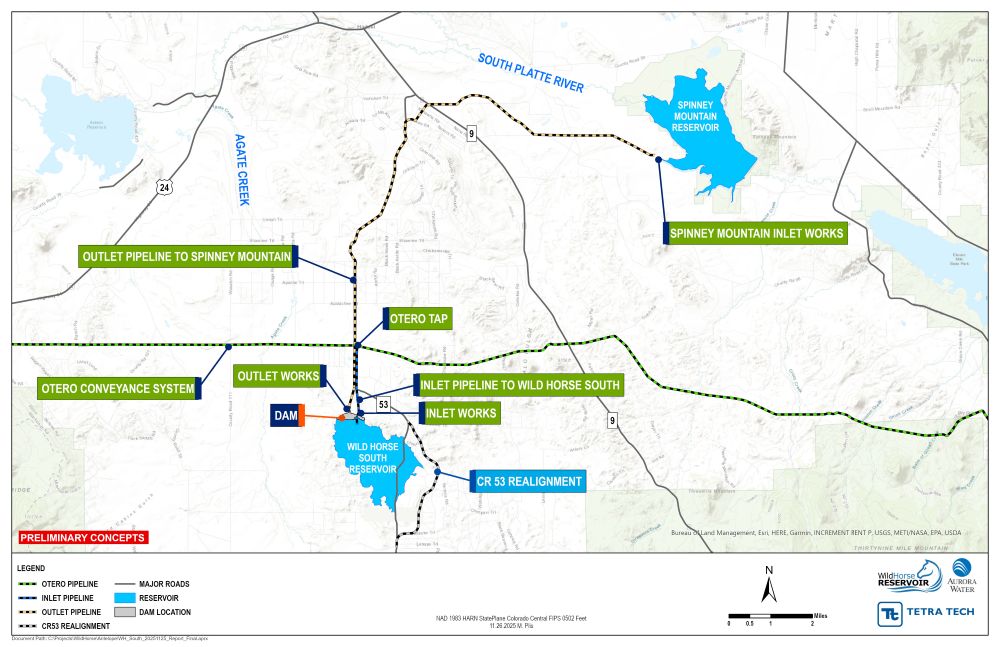
Map of proposed Wild Horse South Reservoir site. Click for larger image.
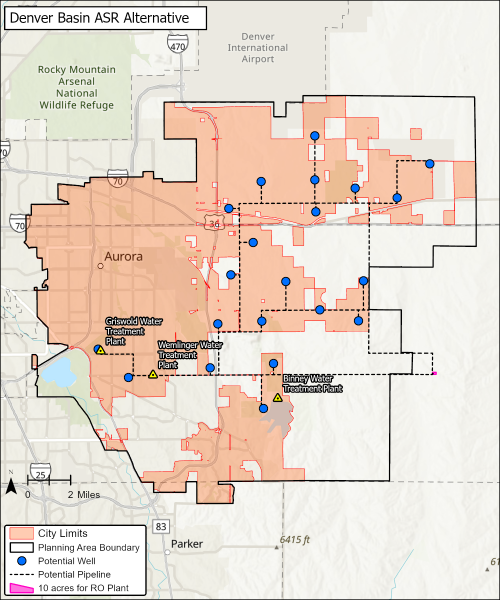
Map of Denver Basin Aquifer Storage and Recovery (ASR). Click for larger image.
The original location for the Wild Horse Reservoir Project is in Park County, Colorado, approximately six miles west of Spinney Mountain Reservoir near Hartsel. The reservoir—which would cover a surface area of approximately 1,700 acres and store 95,000 acre-feet of water—would be off channel, meaning no dams would block existing rivers or streams. Water would be supplied into the reservoir through a new inlet pipeline connected to the existing Otero pipeline. A new outlet pipeline would transport water from Wild Horse Reservoir to Spinney Mountain Reservoir as needed.
Importantly, water stored in the proposed reservoir would be supplied from Aurora Water’s existing Colorado and Arkansas River water rights so no new water rights or decrees would be required.
UPDATE: During evaluation of the alternative sites, Aurora Water identified the Wild Horse South Reservoir alternative as the location to advance for further environmental review and permitting. Key considerations include fewer dams (one versus three), lower operational and construction risks, no additional pumping required to fill the reservoir, and minimal wetland impacts.
The Wild Horse South Reservoir Alternative would consist of a reservoir storing 95,000 acre-feet of water in Park County, Colorado, approximately 10 miles south of Hartsel and approximately 10 miles southwest of Spinney Mountain Reservoir. The reservoir would be off channel, meaning no dams would block existing rivers or streams. Water would be transported to the reservoir through a new inlet pipeline connected to the existing Otero pipeline. A new outlet pipeline would transport water from the reservoir to Spinney Mountain Reservoir as needed. The reservoir would require one dam. Similar to the original location, no new water rights or decrees would be pursued for this alternative.
The Small Wild Horse Reservoir + Denver Basin Aquifer Storage and Recovery (ASR) Alternative would consist of:
- A reservoir storing 45,000 acre-feet of water located in Park County, Colorado, about six miles west of Spinney Mountain Reservoir near Hartsel.
- A system of deep underground wells and pipelines located within the city of Aurora, Colorado, in Arapahoe County.
The smaller reservoir would be off channel, meaning no dams would block existing rivers or streams. Water would be transported to the reservoir through a new inlet pipeline connected to the existing Otero pipeline. A new outlet pipeline would transport water from the reservoir to Spinney Mountain Reservoir as needed. Similar to the proposed action, no new water rights or decrees would be pursued for this alternative.
The ASR system would include 21 ASR well sites and a network of pipelines for storage in the Denver Basin Aquifer. The ASR wells would be deep aquifer wells that would allow water to be injected and withdrawn from the aquifer. A new pump station at Griswold Water Purification Facility (WPF) would pump the treated water through a bidirectional pipeline network to the ASR wells to inject for storage. The ASR wells would withdraw stored water as needed and then pump the water to a desalination facility for treatment and back to Griswold WPF for treatment and distribution.
NOTE: BLM made the decision to exclude Spinney Mountain Reservoir Enlargement Alternative from further detailed analysis in February 2026 because it would not meet Aurora Water’s Goal and Objective for the project and would result in significant short- and long-term environmental impacts.
The existing Spinney Mountain Reservoir is located in Park County below the confluence of the Middle Fork and South Fork of the South Platte River, approximately three miles upstream from Eleven Mile Canyon Reservoir. The Spinney Mountain Reservoir Enlargement Alternative consists of increasing the storage capacity of the existing on-channel (South Platte River) reservoir by an additional 130,000 acre-feet to a total of 184,000 acre-feet. The Spinney Mountain Reservoir Enlargement Alternative would require the existing dam to either be raised by 22 feet or replaced with a new dam constructed downstream of the existing dam. A new saddle dam on the northern end of the reservoir would also be required to complete the enlargement. Similar to the proposed action, no new water rights or decrees would be pursued for this alternative.
The No Action Alternative consists of an ASR system located within the City of Aurora, Colorado, in Arapahoe County. The ASR system would include 21 ASR well sites and a network of pipelines for storage in the Denver Basin Aquifer. The ASR wells would be deep aquifer wells that allow water to be injected and withdrawn from the aquifer. A new pump station at Griswold Water Purification Facility (WPF) would pump the treated water through a bidirectional pipeline network to the ASR wells to inject for storage. The ASR wells would withdraw stored water as needed and then pump the water to a desalination facility for treatment and back to Griswold WPF for treatment and distribution.
Surveys for NEPA Process
With landowner permission, natural resource and cultural surveys were conducted on the proposed project site and alternatives in 2025. More non-invasive surveys will be conducted in 2026 at the Wild Horse South Reservoir location with landowner permission. Some landowners will be contacted to request permission to access private property for the surveys. This information is needed for the evaluation of the site and will focus on areas that have not yet been assessed. Please email us at WildHorseReservoir@auroragov.org with any questions or concerns.